Your Guide to Somerville Green Line Extension Living
What if your morning ride into Boston was a simple, one-seat trip and your evening stroll included a stop at Bow Market or a quick spin on the Community Path? If you are weighing a move in Somerville, that is now a daily reality along the Green Line Extension. You might be early in your search, but you want clear, local insight on transit, neighborhood life, and what this all means for home prices. Here is a practical, source-backed guide to living near Union Square, Gilman Square, and Ball Square so you can decide where to focus. Let’s dive in.
The Green Line Extension reshaped Somerville’s access to rapid transit and daily mobility. City materials note that the share of residents within a half mile of rapid transit jumped from about 15% to roughly 85% once service opened. That scale of access makes the corridor a focal point for transit-oriented living and new development. You feel it on the street as more shops, restaurants, and homes cluster near stations.
For buyers, the bottom line is simple. You now have neighborhoods where trains, bikes, and walkable errands fit together with less reliance on a car. That convenience also raises demand near stations, which affects pricing and competition.
Union Square has long been Somerville’s lively commercial heart with independent restaurants and local shops. The station supercharged interest by making it a clear transit hub. Expect a mix of longstanding favorites and new concepts, with Bow Market as a key draw for food, retail, and community events. For a feel of the scene, browse a local guide to spending a day at Bow Market and Union Square.
On the housing side, Union Square features the largest-scale new development in the city. A good example is Prospect Union Square, a major mixed-use project that began leasing in 2023 and is marketed on its immediate station access. Project materials note that a portion of units are permanently affordable. See the development’s leasing milestone covered by Banker & Tradesman. The station area is also tied to master-planned redevelopment under the city-selected developer team. You can read about the selection of US2 as master developer on the City of Somerville’s news page.
What this means for you: if you want newer, amenity-rich buildings next to a Green Line stop with active street life, Union Square is worth a close look. It is also where competition can be strongest for brand-new homes.
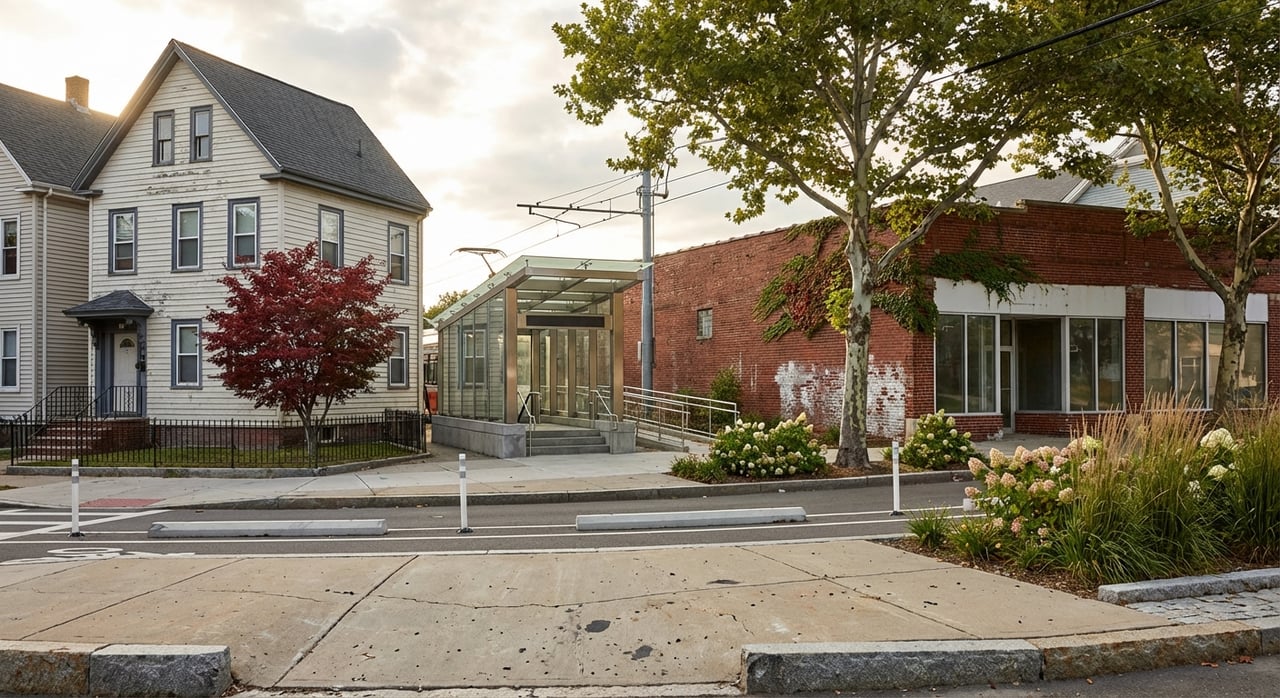
Gilman Square sits near City Hall and Somerville High School and reads as a classic residential pocket with a blend of historic triple-deckers, small apartment buildings, and local retail. The GLX station is below grade, fully accessible, and tied into the Community Path. It also carries notable bike capacity. The station includes a 100-space Pedal & Park bike cage plus racks, which is a real plus if you favor multimodal commuting. See station features summarized on the Gilman Square station page.
Change here has been more incremental than in Union Square. You will see smaller condo buildings, renovated units in older homes, and steady multi-family transactions. For buyers who like neighborhood-scale streets and a central address, Gilman offers a balance of transit access with familiar Somerville housing types.
Ball Square sits at the Somerville–Medford line along the Broadway and Boston Avenue corridor. The new station improved direct access to the Green Line, which helps commuters who want straightforward connections into Cambridge and Boston. The area maintains a neighborhood commercial strip and a local feel, with development skewing toward smaller infill and rehabilitations rather than large tower projects. For context on the area’s character, see the Ball Square overview.
If you want walkable everyday errands and a train a short walk away, Ball Square is a compelling, practical option to tour.
The GLX delivers the one-seat Green Line ride that many Somerville addresses lacked before. That means fewer transfers and a faster, more predictable commute to Cambridge or downtown Boston. The extension also stitched in the Community Path, giving you a car-light way to reach North Point and connect toward Charles River paths. The city’s GLX page highlights how the new stations pair with local buses, biking, and the path for a complete daily network. You can see this multi-modal framing on the City of Somerville GLX page.
Station design supports this lifestyle. At Gilman Square, for example, you will find the large bike cage and Community Path connections that make it easy to ride to the train. You can preview these details in the Gilman Square station summary. Across the corridor, expect practical choices to walk, bike, and train, with less pressure to keep a car.
Somerville’s baseline housing math sets the stage for what you will see near stations. The city has a relatively low owner-occupancy rate of about 34% and high housing costs. Census QuickFacts place median owner-occupied values roughly in the 900 thousand to 911 thousand range and median gross rent near 2,400 to 2,517 dollars, depending on the period measured. You can review these figures in Census QuickFacts for Somerville.
Planning analyses anticipated that the GLX would raise demand and nearby land values. The Metropolitan Area Planning Council’s research, shared through local community groups, modeled property value increases in the mid-teens to mid-20s percent in many station-area scenarios, along with rent pressure if supply and affordability measures lagged. You can read a concise summary in the Dimensions of Displacement report materials.
In the years since the project came into focus, Union Square has seen the largest-scale response, with master-planned sites, newer apartments, and lab and office projects positioned around the station. The city details the Union Square master developer selection and project framework on its news page. Smaller condo and multi-family infill continues in Gilman and Ball Squares, where you will more often find renovated units in older buildings rather than large towers.
For buyers, the implications are clear:
If you are comparing Union, Gilman, and Ball Squares, use a simple, practical checklist to focus your search.
Service patterns will continue to adjust as the MBTA fine-tunes operations. As with any new transit segment, it is smart to keep an eye on service updates during peak hours. On the ground, expect ongoing leasing at newer buildings in Union Square and steady infill in Gilman and Ball Squares. The Community Path will remain a quality-of-life asset that ties the corridor together.
If you want tailored guidance on how station proximity, building age, and development timelines should shape your offer strategy, we can help you model your options.
Ready to explore condos, multi-family opportunities, or single-family homes near the GLX? Start a focused search with The McLaren Team. We blend city and suburban expertise to help you compare neighborhoods, preview new development, and move with confidence.
Whether you are interested in selling your home or buying a new dream home, we make it our mission to be by your side every step of the way and long after the closing. Simply put, our goals are your goals. Contact The McLaren Team today to discuss all your real estate needs!
GET IN TOUCH WITH OUR TEAM TO LEARN MORE
THE MCLAREN TEAM
48 MOUNT VERNON ST STE 205 WINCHESTER MA 01890 126 NEWBURY STREET BOSTON MA 02116