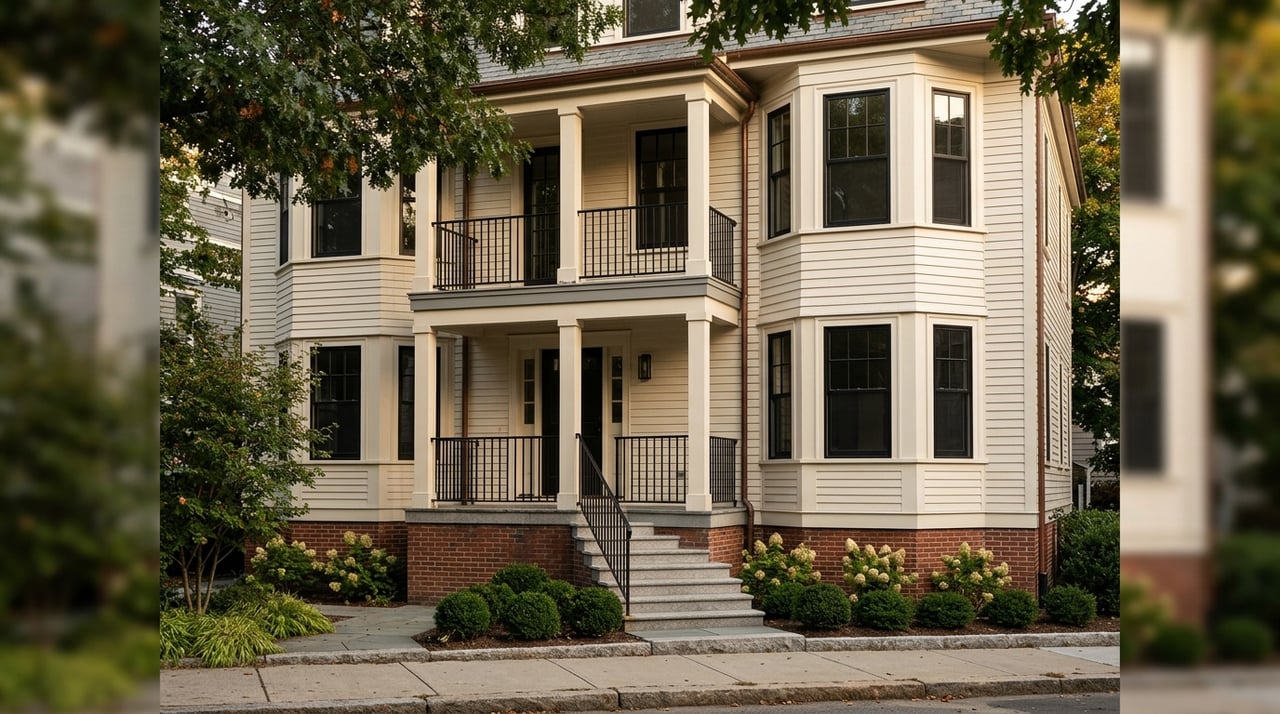
Cambridge Investment Property Guide for Condos and 2-Families
Thinking about buying an investment property in Cambridge? You are not alone, and you are also looking at one of the toughest markets in Greater Boston to enter. High prices, limited supply, and deep renter demand can make Cambridge feel intimidating at first, but they also help explain why investors keep showing up. In this guide, you will learn how condos and small multi-families compare, what the numbers suggest, and where to focus your attention before you make a move. Let’s dive in.
Cambridge is not usually a market where investors chase big day-one cash flow. It is better understood as a scarcity-driven market where long-term appreciation, steady renter demand, and rent growth often do more of the heavy lifting than a high starting yield.
That backdrop starts with supply and pricing. In 2024, the city reported median sale prices of $870,000 for condos, $1,542,500 for two-families, and $1,822,500 for three-families. Those numbers set a high bar for entry, but they also show why Cambridge real estate tends to attract buyers who are thinking several years ahead.
Cambridge has a renter base that is unusually deep for a city of its size. Harvard reported 24,317 degree students in Fall 2025, and MIT reported 11,816 students in 2025-26. Cambridge’s FY24 ACFR also states that Harvard and MIT together employ more than 21,500 people.
The city’s job base adds another layer of demand. Cambridge reports 1.26 jobs for each resident, and major employers include Harvard, MIT, Cambridge Innovation Center, Takeda, Sanofi, Novartis, Biogen, Google, HubSpot, and Broad Institute. That mix supports demand from students, faculty, researchers, and life-science professionals.
At the same time, supply remains tight. Cambridge notes that educational institutions house a large proportion of students, and the city’s housing counts include units under construction and graduate-student apartments while excluding dormitories. In plain terms, the number of market-rate units investors are competing for is tighter than a basic housing stock figure might suggest.
For 2025 Q3, Cambridge’s median asking rents were $2,785 for a one-bedroom, $3,400 for a two-bedroom, and $3,900 for a three-bedroom. Those are meaningful rent levels, but they need to be viewed alongside high acquisition costs.
That is why Cambridge often works best as a long-term hold story rather than a bargain-yield story. Strong rents help, but purchase prices are also high enough that your margin for error can be smaller than in other submarkets.
It is also important to keep rent data in context. The city’s official rent figures are based on advertised market-rate listings, while Zillow uses a different methodology for average rent estimates. Those numbers can be useful directionally, but they should not be treated as interchangeable.
If you are deciding between a condo and a two- or three-family property, the right choice usually comes down to entry price, risk tolerance, management style, and long-term goals.
A Cambridge condo is often the more accessible entry point. With a 2024 median sale price of $870,000, condos are materially less expensive than a two-family or three-family property, which can make them more realistic for first-time investors or buyers planning to live in the unit for a period of time.
Condos can also offer a simpler ownership experience. In many cases, you are managing one unit rather than an entire building, which may reduce maintenance exposure and day-to-day operational complexity.
The tradeoff is concentration. Your investment performance is tied to one unit’s rent, resale value, finish level, HOA structure, and location. If the building has higher fees or the unit lacks features renters expect in that specific micro-market, you have less room to balance that risk with another income stream.
Two- and three-family properties offer multiple income streams, which can create more flexibility. If you plan to live in one unit and rent the others, a small multi-family may support a classic house-hack strategy while giving you a foothold in a high-demand market.
That said, small multi-families come with more moving parts. You are taking on more maintenance, more systems, and more compliance responsibilities than you typically would with a condo. In Cambridge, that matters because the operating environment is more regulation-heavy than in many nearby suburbs.
Small multi-families in Cambridge are also rarely pure cash flow plays. With median prices above $1.5 million for two-families and above $1.8 million for three-families, investors often buy them for a blend of income, appreciation, and future optionality.
Recent examples show how Cambridge pricing can compress returns. A recent seven-unit Cambridge sale traded at a 4.29% cap rate, and a 14-unit mixed-use Cambridge sale traded at a 5.94% cap rate. Nearby Somerville and Charlestown posted a 4.7% market cap rate in a recent Greater Boston report, while Boston multifamily averaged 5.75% across 2025 transactions.
For you, the takeaway is simple: Cambridge investors are often paying for scarcity, location, and long-term resilience. That can still make sense, but it requires disciplined underwriting and realistic expectations about near-term yield.
Cambridge approved a zoning reform on February 10, 2025, that allows multifamily housing in all residential districts. In most areas, up to four stories are allowed by right, and lots over 5,000 square feet may allow up to six stories if 20% of residential floor area is permanently affordable.
This is meaningful, but it does not mean every site becomes easy to develop tomorrow. Historic review, building codes, climate-resilience requirements, and inclusionary housing rules still apply. For investors, the practical takeaway is that long-run development potential may improve, but near-term supply is still constrained.
Cambridge is not under rent control today. Massachusetts law includes the Rent Control Prohibition Act, and Cambridge is not listed among municipalities with rent control.
Still, that does not mean the city is hands-off. Cambridge’s local framework is better described as tenant-protective and compliance-heavy, with notice and tenant-rights requirements that owners and managers need to understand from the start.
There is also policy risk to keep on your radar. Market research has flagged a potential statewide rent-control ballot measure in 2026, which means future rent-growth assumptions should be treated as sensitive to legal and policy changes, not just market conditions.
No matter which property type you choose, Cambridge rewards investors who stay conservative in their assumptions.
Purchase prices are high relative to rents. A deal can look acceptable on paper, then underperform if repairs, taxes, or turnover costs come in higher than expected.
Cambridge has a strong demand base, but it is also concentrated around universities and biotech. Leasing patterns can be shaped by academic calendars, employer hiring cycles, and block-by-block differences in renter demand.
Older housing stock and local compliance obligations can create more hands-on ownership than some buyers expect. If you are comparing Cambridge to suburban rental ownership, this is one of the biggest differences to factor in.
A condo may be the better fit if you want a lower entry point, simpler ownership, and a more manageable first investment. It can also make sense if you value flexibility and want exposure to Cambridge without taking on an entire building.
A two- or three-family may be the better fit if you want multiple income streams, plan to live in one unit, or are comfortable with a more involved ownership role. You may accept a more complex operating picture in exchange for scale and long-term upside.
In either case, Cambridge tends to favor buyers who are patient, well-prepared, and focused on quality over shortcuts. The market can be unforgiving if you overestimate rent, underestimate expenses, or ignore local operating rules.
Before you buy, it helps to walk through a simple checklist:
In Cambridge, details matter. The strongest deals are often the ones that still make sense after you pressure-test the numbers.
If you are weighing a Cambridge condo against a small multi-family, a local strategy matters as much as the spreadsheet. The McLaren Team can help you evaluate opportunities with a clear eye on pricing, property type, and long-term fit across Greater Boston.


Whether you are interested in selling your home or buying a new dream home, we make it our mission to be by your side every step of the way and long after the closing. Simply put, our goals are your goals. Contact The McLaren Team today to discuss all your real estate needs!
GET IN TOUCH WITH OUR TEAM TO LEARN MORE

THE MCLAREN TEAM
48 MOUNT VERNON ST STE 205 WINCHESTER MA 01890 126 NEWBURY STREET BOSTON MA 02116