Brookline Single-Family Homes: Styles, Eras, And What They Mean
Looking at single-family homes in Brookline, it is easy to focus on curb appeal first. A steep Tudor roof, a formal Colonial Revival facade, or a textured Queen Anne exterior can all feel very different at first glance. But in Brookline, style is more than looks. It often tells you something about the home’s age, layout, upkeep, and renovation path. If you are trying to buy, sell, or simply understand the market, knowing what these styles usually mean can help you make smarter decisions. Let’s dive in.
Brookline has a housing story that is different from many nearby suburbs. The town grew from an agricultural community into a streetcar suburb, and by 1900 much of its remaining farmland had been divided into residential development supported by mass transit. That history helps explain why Brookline feels both residential and urban.
The town also has a limited commercial footprint. Less than 6% of Brookline land is zoned commercial, which helps create a dense, walkable, supply-constrained feel rather than a traditional low-density suburb. For you as a buyer or seller, that context matters because the setting around a home often shapes demand as much as the house itself.
Single-family homes are especially notable in Brookline because they can feel scarcer than zoning alone would suggest. As of 2020, 32% of Brookline’s housing units were single-family homes, even though 76% of the town’s residential land was zoned single-family. That mismatch helps explain why detached homes often hold a strong position in the market.
Price reinforces that point. Brookline’s FY2024 appendix reports a median assessed value above $2.34 million for a single-family home. While values vary by property and location, the overall single-family market sits in a very high-value tier.
In Brookline, age is not a side detail. It is one of the first things you should understand about a home. The town’s 2016 Housing Production Plan states that more than half of Brookline’s housing stock was built before 1939.
That older housing stock is a big reason Brookline offers so much architectural variety. It also means many homes can come with higher maintenance and operating costs. Older buildings may need more attention around systems, energy performance, and code-related updates.
For you, that creates a simple rule of thumb. The older the house, the more important it is to separate charm from condition. A beautiful facade may come with years of thoughtful upgrades, or it may point to projects still ahead.
Brookline has relatively few very early houses, but they do exist. Local historic materials note that Walnut Street includes some of the oldest surviving homes in town, with only four surviving houses there that predate 1844.
When you encounter one of these early homes, you are often looking at a house from a very different period of living. These homes may have smaller, more formal original floor plans and proportions that do not match modern expectations for open flow. That can be part of their appeal, but it also affects how comfortably the house fits your day-to-day needs.
For sellers, these homes often appeal to buyers who value age and architectural history. For buyers, the key is to look closely at how additions, kitchen updates, and system improvements have been handled over time.
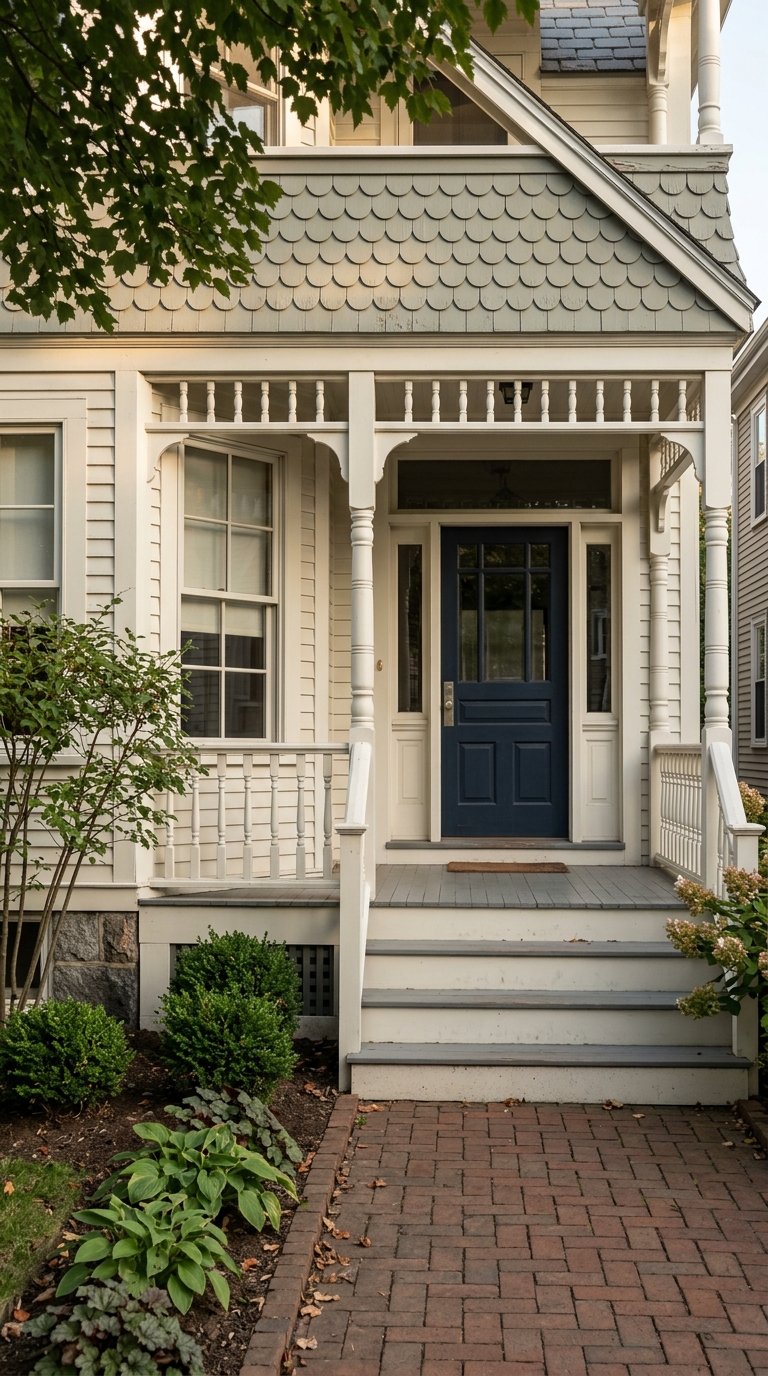
Brookline has a strong collection of 19th-century houses, and many of them fall into Victorian-era styles. In local district materials, Brookline highlights Gothic Revival, Mansard, Queen Anne, Italianate, Shingle, and other stylistic examples in areas such as Cottage Farm.
These homes often stand out because of asymmetrical facades, varied rooflines, porches, towers, and textured materials. In simple terms, they usually offer more visual character and more design detail than a straightforward rectangular house. That can be a major draw if you want a home with personality.
What does that mean in practical terms? Usually, more exterior complexity means more maintenance points. Roof transitions, flashing, trim, masonry, and decorative elements often require more ongoing attention than a simpler house style would.
For buyers, that does not mean avoiding these homes. It means budgeting for the reality that a highly detailed exterior may be part of both the charm and the ownership cost.
Many later-19th and early-20th-century Brookline homes lean toward Revival styles. Local district materials point to Colonial Revival, Georgian Revival, and Shingle-style homes in places such as Chestnut Hill North and Crowninshield.
These homes often read as more orderly from the street. Features may include symmetrical facades, center entrances, dormers, and formal window arrangements. A local report on 40 Norfolk Road describes a Colonial Revival home with exactly that kind of composition.
For you, these style cues often suggest a more formal room organization and a layout that may be easier to update or expand than a highly irregular Victorian shell. That does not guarantee a simple renovation, since later alterations matter too, but many buyers find these homes easier to understand and plan around.
This is one reason Colonial Revival and related styles tend to have broad appeal. They can offer historic character while still fitting modern expectations for room arrangement and daily use.
Tudor Revival is another visible part of Brookline’s single-family landscape. Local district materials identify Tudor Revival homes in places such as Chestnut Hill North and along Harvard Avenue.
You can usually spot this style through steep roofs, half-timbering, and prominent chimneys. These features give Tudor homes a strong visual identity and a very distinctive street presence. For many buyers, that look is part of the attraction.
At the same time, those same elements can point to more complicated upkeep. Steep roof forms and substantial masonry may require careful maintenance over time. If you are comparing styles, this is one of the clearest examples of how architecture can shape ownership responsibilities.
Brookline is not only about older traditional houses. The town also includes mid-century modern and postwar homes, including examples from the 1930s through the 1950s and 1960s.
These homes often offer simpler massing, larger windows, and more open interiors. If you prefer cleaner lines and less compartmentalized space, this era can feel more aligned with current living patterns. In some cases, that means fewer layout compromises than you might find in a much older house.
Still, mid-century does not always mean low-maintenance. Older windows, insulation, and energy performance can still be part of the conversation. Buyers should review these homes with the same care they would bring to any older property.
Brookline also has newer single-family homes, but they usually appear as infill or replacement construction rather than large-scale new subdivisions. That is an important distinction because newer homes in Brookline are shaped by the town’s built-out setting and expensive land.
For you as a buyer, newer construction may offer more predictable layouts and more modern systems. That can be appealing if you want updated infrastructure and less immediate renovation work. But it is still wise to understand how the home fits into the street and whether its design or approvals were shaped by preservation review.
For sellers of newer homes, the value story is often different from that of a historic house. Buyers may focus more on layout, systems, and finish level than on period detail.
In Brookline, preservation status is not just background information. It can directly affect what you can change. The town states that most exterior modifications and some landscape alterations in local historic districts require review.
The Preservation Commission also explains that demolition delay review can apply to complete or partial demolition of buildings in Brookline. In practical terms, you should never assume a dormer, addition, window change, or teardown-and-rebuild plan will be simple.
Brookline’s preservation framework is substantial. The town’s archived Preservation Commission page says Brookline has 8 local historic districts, 16 National and State Register districts, and more than 80 National and State Register individual listings. If you are buying with renovation in mind, confirming district status early is one of the most important steps you can take.
Style explains the house, but location within Brookline often explains demand, convenience, and daily lifestyle. The town identifies eight commercial areas: Coolidge Corner, Brookline Village, Washington Square, JFK Crossing, St. Mary’s, Chestnut Hill, Putterham Circle, and Commonwealth Avenue. Each is part of a residential neighborhood context.
For many buyers, living closer to one of these village centers means easier access to errands, dining, services, and everyday activity. That relationship between quiet residential streets and active village centers is one of Brookline’s defining traits.
Transit is another major differentiator. Brookline says the MBTA Green Line serves the town through the C and D branches, with the B line accessible to North Brookline and the E line accessible from Brookline Village. The 66 bus also runs through Brookline Village and Coolidge Corner, and Bluebikes stations are located in several village areas.
That access shapes how people live. Brookline reports that 20.5% of households own no vehicles, 46.6% own only one vehicle, and nearly 68.5% of workers either walk, bike, take public transportation, or work from home. If you are comparing two homes with similar style and condition, access to transit and village amenities may become a major deciding factor.
Green space also plays a meaningful role. Brookline says it has 506 acres of protected public and private conservation and park land, including Larz Anderson Park and the Riverway and Olmsted Park section of the Emerald Necklace. For many buyers, proximity to open space adds to the home’s lifestyle appeal and long-term value perception.
If you are shopping for a Brookline single-family home, style should be the start of your analysis, not the finish line. A home’s era can give you clues about layout, maintenance, and upgrade priorities, but every property has its own history.
Here are a few smart questions to keep in mind:
When you evaluate homes through both an architectural and practical lens, you can compare options more clearly. That is especially important in a market where detached homes are limited and values are high.
If you own a single-family home in Brookline, your home’s style is part of its market story. Buyers are not only reacting to square footage and finishes. They are also reacting to era, character, layout, and the expected level of future upkeep.
That means positioning matters. A Tudor, Queen Anne, or Colonial Revival home should be presented in a way that explains both its architectural value and its practical strengths. If there have been thoughtful upgrades to systems, windows, roofing, or layout, those details can help buyers understand the full picture.
In a high-value market like Brookline, good marketing is not just about beautiful photos. It is also about helping buyers quickly see what kind of home they are looking at, how it lives, and why it stands out in its particular pocket of town.
Brookline single-family homes reward informed buyers and prepared sellers. If you want help reading the market through both style and strategy, The McLaren Team can help you navigate the details with a polished, local, data-informed approach.

Whether you are interested in selling your home or buying a new dream home, we make it our mission to be by your side every step of the way and long after the closing. Simply put, our goals are your goals. Contact The McLaren Team today to discuss all your real estate needs!
GET IN TOUCH WITH OUR TEAM TO LEARN MORE
THE MCLAREN TEAM
48 MOUNT VERNON ST STE 205 WINCHESTER MA 01890 126 NEWBURY STREET BOSTON MA 02116