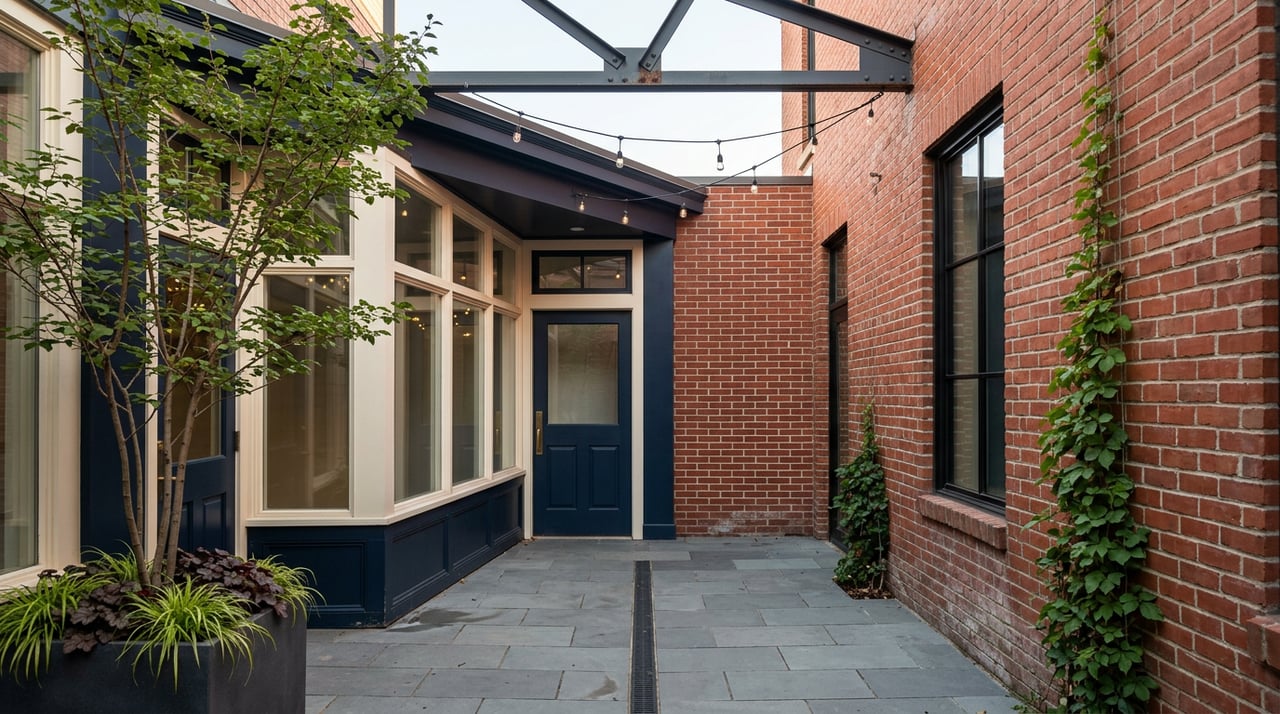
Why Bow Market Somerville Shops Never Stay the Same
Walk down the alley behind Somerville Avenue this month and you'll notice something a Bow Market regular already knows: half the storefronts don't look like they did last summer. A jewelry stall is now a barbershop. A pop-up bakery is now a bookshop that sells mead on the side. If you check back in six months, more will have changed again.
Most people read that kind of churn as a warning sign. In retail, turnover usually means trouble: landlords scrambling to backfill space, empty windows piling up, a shopping center quietly dying one lease at a time. Bow Market runs on the same churn and gets the opposite result. Somerville built a market where businesses are expected to leave, and that expectation is exactly why the courtyard never sits empty.
Bow Market opened in 2018 inside a former U-shaped parking garage tucked behind a Union Square alleyway, the kind of space most developers would have written off as unleasable. As of early 2026, co-founder Zachary Baum told the Boston Globe the market had not gone longer than a month without filling an empty storefront in over two years, even as it has grown to house more than two dozen entrepreneurs.
That single number is the whole story, once you set it against the rest of the region. Food halls and strip malls across Greater Boston have spent the past few years bleeding tenants, and the Globe's own framing called Bow "a stark contrast to the struggling food halls and shopping malls dotting the region." A market that keeps a vacancy under thirty days isn't lucky. It's built differently.
Here's the mechanism most passersby never see: Bow Market's leases are short by design. Retail space is rented for days to weeks. Food pop-ups get six months to a year before they either graduate to their own storefront or hand the space to someone new. Compare that to a typical Somerville Avenue commercial lease, which runs three to five years and is built around keeping a tenant put.
That difference changes what "success" looks like for a landlord. A conventional retail strip needs a tenant to stay forever to justify the buildout costs. Bow Market needs a tenant to stay just long enough to prove a concept, then move on, freeing 165 square feet of prime Union Square frontage for the next idea. The turnover isn't a symptom of fragile small businesses. It's the feature that keeps the alley from ever going stale.
Walk it today and the current mix reflects that model in real time. Remnant Brewing, the market's anchor, still runs its brewery and coffee counter in full view of the courtyard. Nook keeps a rotating cocktail chalkboard. Pop's Pinball Parlor and Green Tiger & Co., the zero-waste refillery, have both stuck around long enough to become fixtures. Newer arrivals show the churn is still active: Side Quest Books & Games, a fantasy-themed bookshop that opened at the end of 2024, KEEPER, a chainstitch embroidery studio that arrived in August 2025, Barber's Den, which took a space in February 2026, and Give Good Home Shop, a vintage home decor storefront that opened this spring.
None of that is static. By next summer, some of those names will have moved on and new ones will have taken their place. That's not a prediction. It's the operating model.
The other half of the story is what happens after a business outgrows its 165 square feet. Bow's founders describe a deliberate goal: for the market's wins to ripple outward into the neighborhood's own commercial fabric rather than stay contained inside the courtyard. Since Bow opened in 2018, a steady stream of its pop-up alumni have graduated into standalone storefronts around Union Square, and the effect has traveled further than Somerville. Hive Public Market, which opened in Lowell in November 2025, drew several vendors from a similar market model and folded them in alongside new entrants.
That's the part a resident feels even without knowing the backstory. The reason Union Square keeps adding small, distinctive storefronts instead of chain retail isn't accidental. It's downstream of a testing ground three blocks away that keeps producing businesses ready to take the next step.
Getting there hasn't gotten easier, even for the people who built it. When Bow expanded by roughly 6,000 square feet onto Somerville Avenue in 2023, the city had since revamped its zoning code and the officials who championed the original project, including former planning chief George Proakis, had already left City Hall. Baum and Boyes-Watson told the Globe that rising construction costs and financing weren't the hardest part. What mattered more was flexibility from City Hall in clearing the regulatory steps required to open at all. Proakis, who now serves as Watertown's city manager, put it a different way: a project like this needs a champion inside local government willing to push it through.
Boyes-Watson framed the fragility of the whole model this way: these projects exist on a knife's edge everywhere they're tried, and a little more friction from a city government is often enough to talk a founder out of trying at all.
Bow's rotating tenant mix isn't the only reason to check back. The market also hosts the Curated Vintage Market, a recurring event that periodically takes over the courtyard and spills out onto Somerville Avenue and Union Tavern. The 13th installment, held in late May, brought more than 80 vintage vendors from across New England for a single day of clothing, antiques, jewelry, and home decor, alongside food specials from Bow's own tenants. It's grown steadily since its early editions a few years back, and it's become the kind of date locals build a Sunday around rather than stumble into.
For a resident, that combination, a courtyard that reshuffles its storefronts constantly plus a periodic event that pulls in dozens of outside vendors, is what makes "just stopping by Bow" a genuinely different experience depending on the week you go.
If you've lived in Somerville for more than a year, you've probably already absorbed this without naming it: Bow Market rewards the habit of checking back rather than treating it as a place you've already seen. The turnover that would sink most retail developments is precisely what keeps this one from ever feeling finished.
That habit says something about Union Square more broadly. A neighborhood commercial district that can sustain a business incubator running at this pace, one that keeps producing graduates for its own storefronts and for markets as far away as Lowell, is a neighborhood with real appetite for small, owner-run businesses rather than a rotating cast of chains. It's part of what gives Union Square its particular texture: dense, walkable, and stocked with places that didn't exist a year ago.
If you're weighing what makes a Somerville block worth living near, the presence of something like Bow Market is a data point most listings won't mention and most spreadsheets can't capture. It's also the kind of neighborhood detail our team spends time tracking, because it shapes daily life in Union Square in ways a median price never will. You can browse more of what's happening across Somerville's neighborhoods, or see current Somerville listings if a move toward Union Square is somewhere on your horizon.
If today's walk through Bow Market has you thinking about what it would mean to live within a few blocks of it, The McLaren Team can walk you through what's actually available in Union Square and the surrounding blocks. Start Your Move.
Whether you are interested in selling your home or buying a new dream home, we make it our mission to be by your side every step of the way and long after the closing. Simply put, our goals are your goals. Contact The McLaren Team today to discuss all your real estate needs!
GET IN TOUCH WITH OUR TEAM TO LEARN MORE
THE MCLAREN TEAM
48 MOUNT VERNON ST STE 205 WINCHESTER MA 01890 126 NEWBURY STREET BOSTON MA 02116