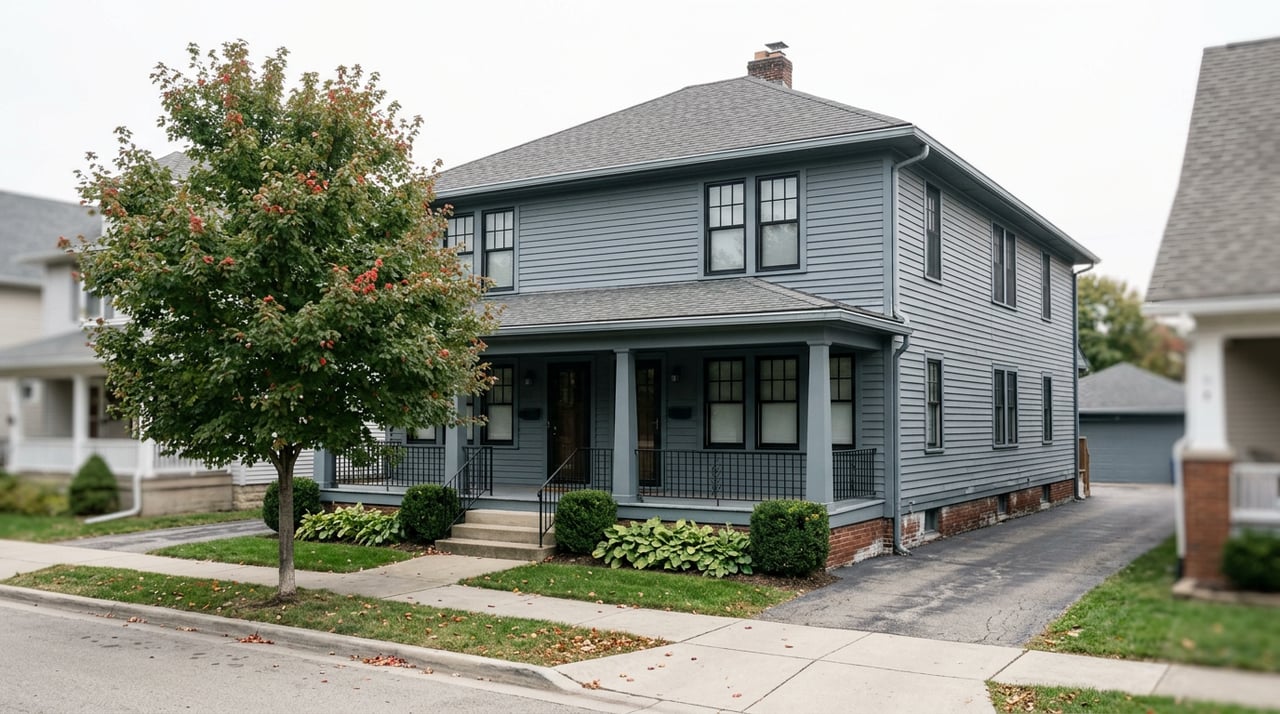
Arlington Zoned Its Mass Ave Corridor for 3,216 New Homes. The Town Itself Only Expected 50 to 200.
Drive down Massachusetts Avenue past Newman Way and you will pass a stretch of two- and three-family houses that look, at a glance, exactly like they did five years ago. One of those lots, at 840-846 Mass Ave, is about to change. In April 2026, Arlington's Redevelopment Board signed off on a six-story building with 28 rental units reserved for households earning up to 60 percent of the area median income, plus a small commercial space on the ground floor. The developer is not a private builder chasing market rents. It is the Housing Corporation of Arlington, a nonprofit, and the project required demolishing an existing two-family house next door at 17 Newman Way to make room.
That approval is worth pausing on, because it is the clearest evidence yet of a zoning change that reshaped what is legally possible on dozens of Arlington parcels, and because it sits right at the center of a gap most people get wrong in both directions. Some assume Arlington is simply out of land and nothing new is coming. Others hear a big zoning capacity number and assume a wave of construction is imminent. Neither read matches the record. If you are buying, selling, or holding property anywhere near Arlington's commercial corridors, the town's own numbers on what it zoned for, and what it actually expected to get built, are worth understanding before you price a listing or write an offer.
Anyone shopping in Arlington this year has heard some version of the same pitch: the town is built out, there is no vacant land for new single-family construction, and that scarcity is what holds prices up regardless of interest rates. The data backs part of that story. Single-family homes sold for an average of $1.51 million across 58 closed transactions year to date through early August 2026, up from $1.39 million over the same period the year before, closing at an average of 107.4 percent of list price and averaging just 10 days to offer. Months of supply sat at 1.4, which is deep seller's market territory by any conventional read.
Condos told a similar but softer version of the same story: $940,000 average across 96 closed sales, up from $928,000, closing at 100.9 percent of list price but taking closer to 28 days to offer, with 1.5 months of supply.
Here is the wrinkle that the "built out" pitch skips over. Townwide, blending every property type together, Arlington's median sale price fell nearly 10 percent over the three months ending June 2026 compared to the same window a year earlier, even as the average sale price for the town rose almost 10 percent over that same stretch. A median that drops while the average climbs usually means a handful of higher-priced sales are pulling the mean upward while the typical, middle-of-the-market sale actually got cheaper. If you are pricing a listing off a single headline number pulled from a portal, that number may not describe the specific type of home you are buying or selling, which is exactly why the property-type breakdown below tells a cleaner story than the townwide blend.
| Property Type | Avg./Median Price (YTD through early Aug. 2026) | Sale-to-List Ratio | Days to Offer | Months of Supply |
|---|---|---|---|---|
| Single-family | $1.51M avg. (58 sales) | 107.4% | 10 days | 1.4 |
| Condominium | $940K avg. (96 sales) | 100.9% | 28 days | 1.5 |
None of this changes the fact that Arlington's single-family stock is genuinely constrained. But that constraint sits inside town limits that were never uniform to begin with, and the zoning map underneath the corridor parcels changed in a way most single-family buyers never think to ask about.
In 2020, the state signed a requirement that every community served by the MBTA, Arlington included, zone for multifamily housing to be built by right somewhere within its borders. Arlington's response took three years to design and adopt. Special Town Meeting approved the town's MBTA Communities Overlay District on October 25, 2023, and the state signed off on the plan in 2024. As an "adjacent" MBTA community, meaning one with bus service but no rail station of its own, Arlington's obligation under the law was to zone for multifamily capacity of roughly 2,046 units, about 10 percent of its existing housing stock.
Arlington went well past that floor. The overlay creates two sub-districts that follow the town's busiest bus corridors from East Arlington to Arlington Heights: a Massachusetts Avenue/Broadway district allowing multifamily buildings up to four stories by right, with a height bonus to six stories on Mass Ave and five on Broadway for projects that add ground-floor commercial space or extra affordable units, and a lower-density neighborhood district just off those corridors allowing up to three stories. The mapped overlay carefully avoids floodplains and locally designated historic districts.
Here is the number that matters most, and the one that almost never makes it into casual conversation about the overlay. The Redevelopment Board's own report to Town Meeting put the mapped districts' total zoning capacity at 3,216 units across 115.6 acres, against roughly 1,981 units already standing on those same parcels at the time of adoption, a theoretical headroom of about 1,235 additional units. But the same report did not predict anything close to that headroom getting built out. The Board's own working projection was that somewhere between 15 and 45 parcels would redevelop over the following ten years, for a net increase of just 50 to 200 new units townwide. The zoning capacity number and the town's own construction forecast were never the same number, and the gap between them was intentional. A capacity figure describes a ceiling. It was never meant to describe a forecast.
If your property, or the one you are considering buying, sits inside that mapped district, its legal ceiling changed in 2023 whether anyone told you or not. Arlington published a specific parcel list when it adopted the bylaw, so whether a given lot qualifies is a parcel-by-parcel question, not a neighborhood-wide assumption.
The honest way to check the overlay's early track record is against the 50-to-200-unit, ten-year projection the Redevelopment Board itself set, not against the 3,216-unit theoretical ceiling. That comparison is still revealing, just not in the way a bigger, scarier number would suggest.
In 2024, the overlay's first year in effect, exactly one application moved through the process: a two-family house on Belknap Street converted into a pair of two-family homes, a net gain of two units. By the fall of 2025, four more applications were working their way through the Redevelopment Board, none yet approved at that point:
A fifth application at 259 Broadway, proposing to convert four apartments into five, was withdrawn after its first hearing. Taken together, if every remaining application had been approved as filed, the net addition would have amounted to roughly 26 homes, a fraction of one percent of Arlington's existing housing stock, according to tracking published by the community group Equitable Arlington.
Then, separately, Emma's Court: the 28-unit project at 840-846 Mass Ave approved in April 2026 by itself accounts for more units than the small conversions filed across the overlay's first two years combined, and lands well inside the Board's own 50-to-200-unit, ten-year range on its own. It took a nonprofit developer, the Housing Corporation of Arlington, with dedicated affordable housing financing to get there, not a market-rate builder testing the corridor for the first time. Two and a half years in, Arlington's corridor redevelopment looks less like a broken promise and more like exactly the slow, parcel-by-parcel pace the town's own planners expected when they set the zoning far above what they actually thought would get built.
For a seller who owns a two-family or small commercial building inside the mapped overlay, the practical takeaway is that your parcel now carries development rights it did not have three years ago, even if you have no intention of building anything yourself. That optionality can show up in what a buyer is willing to pay, particularly an investor evaluating redevelopment math rather than a family looking for a place to live. It is worth confirming your parcel's status against the town's adopted overlay map before setting a list price, since the answer changes what kind of buyer you are actually marketing to.
For a buyer looking at a single-family Colonial a block or two off Mass Ave or Broadway, the overlay does not touch your zoning district directly, and the slow pace of construction so far suggests wholesale redevelopment of the corridor is not an imminent event. What it does mean is that a neighboring commercial parcel could look different in five or ten years than it does today, particularly the ones large enough to make a six-story project pencil the way Emma's Court did.
For anyone evaluating a corridor parcel as an investment or small development play, the lesson from the first two and a half years is that by-right zoning removes a permitting hurdle, it does not remove the underlying economics of construction cost, financing, and, in the one project that has actually broken ground, dedicated affordable housing subsidy. Treat the 3,216-unit capacity figure as a ceiling on what is legally possible, not as a prediction. Arlington's own planners set their real expectation at 50 to 200 units over a decade, and the pace so far is tracking closer to that number than to the ceiling.
Does the overlay apply to my specific property, or just to Arlington generally? It is parcel-specific. Arlington adopted a defined map and parcel list alongside the bylaw, so a property a block off Mass Ave may or may not qualify depending on exactly where the mapped boundary falls.
Could my single-family lot be rezoned for multifamily under this overlay? Not automatically. The MBTA Communities Overlay was mapped onto the town's commercial corridors and a narrow band of adjacent neighborhood parcels. It layers new options on top of existing zoning in those mapped districts, and it does not touch the town's single-family zoning districts elsewhere.
Is more construction coming to Mass Ave and Broadway soon? Based on the pace so far, meaningfully more density will take time. Two and a half years produced one completed conversion, a handful of small pending applications, and one larger approved project built with nonprofit financing rather than private capital, a pace that tracks closer to the town's own ten-year, 50-to-200-unit projection than to the 3,216-unit zoning ceiling.
If you are weighing a purchase or a sale anywhere along Arlington's corridors, or trying to figure out what a parcel's zoning actually allows before you price it, The McLaren Team can walk through the specifics with you, parcel by parcel. Start Your Move.
Whether you are interested in selling your home or buying a new dream home, we make it our mission to be by your side every step of the way and long after the closing. Simply put, our goals are your goals. Contact The McLaren Team today to discuss all your real estate needs!
GET IN TOUCH WITH OUR TEAM TO LEARN MORE

THE MCLAREN TEAM
48 MOUNT VERNON ST STE 205 WINCHESTER MA 01890 126 NEWBURY STREET BOSTON MA 02116